Your closing argument is your final chance to persuade the jury before they deliberate your fate. It’s where you connect every piece of evidence to a single, compelling theme that supports your case. You can’t misstate facts or make inflammatory appeals, but you can strategically frame the evidence to establish reasonable doubt. A strong closing carries enormous persuasive weight because it’s the last thing jurors hear. Understanding its structure and boundaries can make all the difference.
What a Closing Argument Actually Does in a Criminal Trial

Once all evidence has been presented and both sides have rested, the closing argument becomes each lawyer’s final chance to explain why the jury should decide the case in that side’s favor. It’s where your attorney connects the evidence to the legal issues the jury must resolve before reaching a verdict.
A closing argument doesn’t introduce new facts. Instead, it organizes the proof already admitted at trial and shows how it supports your side’s theory. Because it’s often the last thing jurors hear before deliberations, a strong closing argument carries significant persuasive weight. Your attorney will clarify what the evidence means, highlight its significance, and tell the jury exactly what verdict the facts demand, making deliberation more focused and your rights more protected. Through creative strategies and techniques, your attorney dramatizes the case to tell a compelling story that makes the evidence resonate with the jury.
The Constitutional Right to a Closing Argument
| Protection | What It Means for You |
|---|---|
| Sixth Amendment guarantee | You’re entitled to counsel’s summation before deliberations |
| Can’t be eliminated by judges | Reasonable time limits are okay; total denial isn’t |
| Anchored to admitted evidence | Your attorney frames facts in your favor |
| Reversible error if denied | An improper denial can overturn your conviction |
| Last word before deliberations | It directly shapes how jurors evaluate your case |
If convicted, you have ten days to file an appeal challenging any legal errors that occurred during your trial.
How Prosecutors and Defense Attorneys Approach Closing Arguments Differently

Knowing that you’re entitled to a closing argument is one thing, understanding how each side actually uses that argument is another. The prosecution closing argument follows a rigid, element-driven structure, connecting each piece of admitted evidence to specific legal requirements and building toward proof beyond a reasonable doubt. Prosecutors speak first and typically receive rebuttal, giving them two chances to persuade you.
Your defense closing statement operates differently. Rather than proving anything, your attorney targets the State’s weaknesses: inconsistent testimony, investigative gaps, unreliable identifications, and alternative explanations the evidence supports. Defense counsel often uses narrative and humanizing language to reframe how you’re perceived.
Prosecutors face stricter ethical constraints, they can’t vouch for witnesses or misstate evidence. This asymmetry exists because they represent the government’s power against your constitutional rights. Prosecutors must also avoid referencing pre-written arguments citing evidence that was excluded during the trial.
Build Your Closing Argument Around One Clear Theme
Clarity wins jury deliberations. When you build your closing argument around one clear theme, you give jurors a framework to organize every fact in your favor. Your theme should echo your opening statement, creating consistency that feels inevitable rather than manufactured.
Choose a short, repeatable phrase rooted in the heart of your case. Tie each key fact back to that core idea so your argument reads as one cohesive story, not a collection of disconnected points. Use anchor charts, timelines, or witness quotes to reinforce the theme visually.
In closing arguments in criminal cases, a focused theme determines which evidence you emphasize and which you leave behind. Don’t rehash everything, persuade strategically. Place your strongest thematic point last, so jurors carry it directly into deliberations.
A Closing Argument Structure That Holds Juror Attention
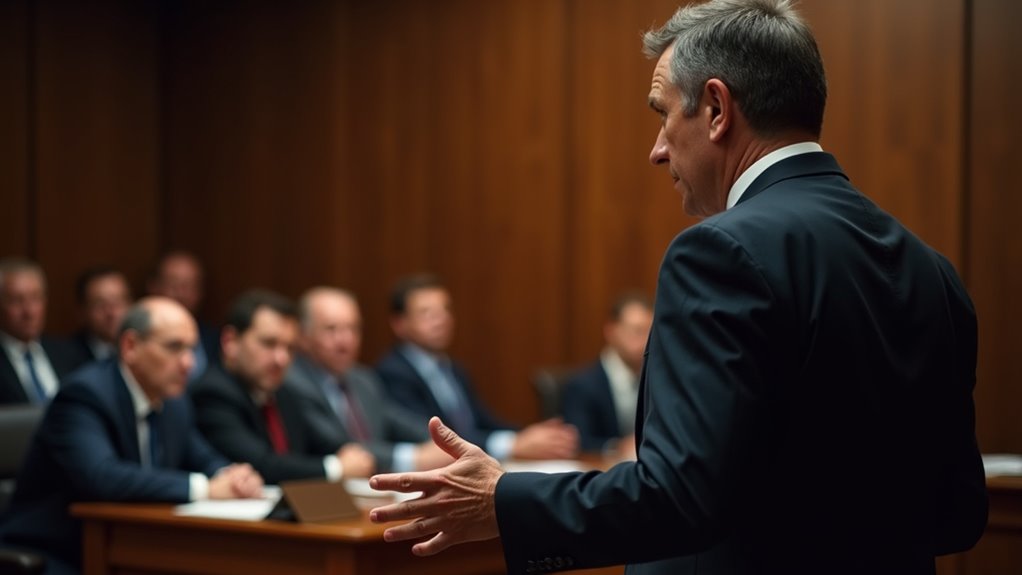
Your closing argument’s structure can determine whether jurors carry your narrative into deliberations or lose it entirely. By leading with your strongest theme, placing your most compelling evidence where it hits hardest, and ending with a clear, memorable call to action, you give jurors a framework they can actually use when deciding your client’s fate. Each of these structural choices, your opening strategy, your evidence placement, and your closing technique, works together to protect your client’s right to a fair and attentive hearing.
Theme-First Opening Strategy
Your theme should echo what jurors heard in your opening statement. That consistency builds credibility and signals deliberate advocacy. Jurors recognize the same story, now confirmed by trial proof. Criminal trial opening statements play a crucial role in shaping jurors’ perceptions. They provide a roadmap for the evidence that will be presented, guiding jurors toward an understanding of the case.
Don’t start with a chronological evidence dump. Start with a short phrase, analogy, or story that captures your entire theory. This creates a mental anchor jurors carry into deliberations.
You’re not introducing something new, you’re paying off a promise. That sense of completion protects your client’s rights when it matters most.
Strongest Points Placement
The order in which you present your strongest points can determine whether jurors carry your theory into deliberations or lose it in a fog of detail.
Start with your second-strongest point to command attention immediately. Cluster remaining arguments in a logical middle sequence, organizing by issue rather than witness order so each chapter builds on the last. Then position your strongest point as the final substantive chapter, right before your direct ask, so it lands with maximum weight after jurors have absorbed your supporting proof.
Anchor each point to specific evidence using headline-style labels. Don’t rehash everything; highlight only dispositive facts tied to legal elements. Integrate burden-of-proof reminders and credibility arguments throughout. This structure guarantees jurors enter deliberations with your most powerful argument freshest in mind.
Memorable Ending Techniques
Everything you’ve built in your closing, every theme, every evidence link, every burden-of-proof reminder, rises or falls on how you end. Memorable ending techniques leverage recency bias, ensuring your final words dominate deliberation. Structure your finish around three elements:
- Echo your opening theme. Circle back to your hook so jurors hear a unified narrative, not scattered arguments.
- Tell the story’s final chapter. Use descriptive, client-focused language that makes your theory feel inevitable rather than argued.
- Deliver a direct call to action. Walk jurors through the verdict form, connecting each answer to specific exhibits and testimony.
Don’t end with open-ended reflection. End with a confident, specific verdict request, something stirring that rings in jurors’ ears when they enter that deliberation room.
Ethos, Pathos, and Logos in a Criminal Closing Argument
A powerful closing argument rests on three pillars: your credibility before the jury, your ability to connect the evidence to what matters emotionally, and your logical command of the facts and law. You can’t win a verdict on passion alone, and you can’t hold a jury’s attention with logic that lacks heart. When you balance ethos, pathos, and logos effectively, you give jurors both the reason and the resolve to protect your client’s rights.
Building Credibility Through Evidence
Because jurors decide your client’s fate based on what they believe, not just what they hear, closing argument demands more than a summary of evidence. Your credibility becomes the lens through which jurors interpret every fact. During evidence review closing arguments, you must anchor each claim to specific proof, exhibit numbers, documented testimony, and admitted records.
Build trust through three deliberate practices:
- Connect every assertion to admitted evidence rather than broad generalizations that jurors can’t verify.
- Acknowledge weaknesses candidly so the jury sees you as honest, not evasive.
- Use precise language and accurate visual aids to reinforce reliability and avoid any appearance of manipulation.
When you present yourself as a credible guide through the proof, jurors are far more likely to protect your client’s rights.
Emotional Appeals Done Right
Credibility anchored in evidence gives your argument its foundation, but facts alone won’t move a jury to act. Emotional appeals done right connect admitted proof to human experience without crossing into sympathy-based manipulation. You can evoke empathy, anger, or justice, but every emotional thread must tie back to the record.
Effective courtroom advocacy techniques pair narrative with logic. Use metaphors and simple phrasing jurors carry into deliberations. Repeat your strongest evidence-based points rather than piling on volume. Avoid “I believe” language; let the facts speak through storytelling that humanizes your client’s position.
Your closing statements should align the dominant emotion in the case with your theory of defense. Frame the story around your client’s constitutional rights, not personal identification. That’s how you persuade without overstepping.
Logical Reasoning Wins Verdicts
While emotional appeals ground your closing in human experience, logical reasoning is what actually wins verdicts. You must build your argument on evidence admitted at trial, drawing reasonable inferences that track each element of the offense. When your logic is airtight, jurors can’t ignore it during deliberation.
Structure your closing around three core principles:
- Match every element of the charged offense to specific testimony, exhibits, or forensic findings.
- Present a coherent theory that makes all the evidence consistent and easy for jurors to follow.
- Argue reasonable inferences that flow naturally from the facts, never speculation or unsupported claims.
Logical reasoning wins verdicts because it respects your jury’s intelligence and protects your client’s constitutional rights through disciplined, evidence-based advocacy.
What the Law Prohibits in a Closing Argument
Although closing arguments give attorneys wide latitude to interpret evidence and advocate for their position, the law draws firm boundaries that protect your right to a fair trial.
Attorneys can’t misstate evidence, inject personal opinions, or vouch for witnesses. They can’t make inflammatory appeals to prejudice, sympathy, or fear. “Golden Rule” arguments asking jurors to imagine themselves in your position are prohibited.
Among the most critical protections are restrictions on forbidden topics and excluded matters. Prosecutors can’t comment on your decision not to testify or suggest you carry any burden of proof. They can’t reference evidence the court excluded or discuss punishment outside the jury’s role.
These rules exist to guarantee your verdict rests on admitted evidence and accurate legal standards, nothing else.
Closing Argument Mistakes That Create Appellate Risk
Knowing the rules matters, but understanding how violations actually play out, and the appellate consequences they carry, gives you a sharper sense of what’s at stake when an attorney crosses the line during closing argument.
Here are three closing argument mistakes that create appellate risk:
- Misstating evidence or arguing facts outside the record. Courts treat the trial record, not counsel’s narrative, as the only proper basis for summation. Overstating testimony can trigger mistrial motions.
- Vouching for witnesses or injecting personal opinions. Statements like “I believe” substitute counsel’s credibility for the evidence, and appellate courts won’t tolerate it.
- Shifting the burden of proof. Even indirect suggestions that you had to produce evidence violate your constitutional rights and can warrant reversal.
Your verdict should rest on evidence, not prosecutorial overreach.
Using Your Closing Argument to Establish Reasonable Doubt
Because the prosecution carries the burden of proving every element beyond a reasonable doubt, your closing argument isn’t about proving innocence, it’s about showing the jury exactly where that burden falls short. You should connect each weakness in the State’s case directly to the specific elements prosecutors must prove. The prosecution’s burden of proof is a critical aspect of any criminal trial. Jurors must be reminded that reasonable doubt exists when evidence does not convincingly support the charges.
Challenge witness credibility, expose forensic gaps, and highlight contradictions that undermine the prosecution’s narrative. Present alternative explanations as plausible interpretations the evidence supports, you don’t need to prove them conclusively. When jurors see the evidence fits more than one reasonable interpretation, reasonable doubt exists.
Structure your argument clearly: identify the weakest links in the prosecution’s chain, tie them to the presumption of innocence, and make a direct, confident request for acquittal. Every word should reinforce that the State hasn’t met its burden. Understanding the stages of a criminal trial in Georgia is essential for mounting a strong defense. This knowledge allows you to anticipate the prosecution’s strategy and prepare your case effectively.
Get the Trial Defense You Deserve
Every phase of a criminal trial matters, from jury selection to closing arguments, and skilled representation can shape the entire outcome. At Cobb Defense in Marietta, GA, our experienced attorneys provide trusted Criminal Defense with skill, dedication, and a personalized strategy. Call (770) 627-3221 today and take the first step toward protecting your rights.
Frequently Asked Questions
How Long Do Closing Arguments Typically Last in a Criminal Trial?
You can expect closing arguments to last anywhere from 30 minutes to a few hours per side, depending on your case’s complexity. In routine misdemeanors, they’re often under an hour. For serious felonies, courts may allow two hours or more per side. There’s no universal time limit, judges set the pace based on the evidence and issues involved. Your attorney should use every minute to protect your rights and challenge the prosecution’s case.
Can Jurors Ask Questions or Request Clarification During Closing Arguments?
Generally, you can’t ask questions or request clarification during closing arguments. You’re expected to listen while attorneys summarize the evidence and make their case. If you need clarification, you’ll typically raise it during deliberations or through the judge’s established procedures. Some jurisdictions allow juror questions during the evidence phase, but closing arguments follow stricter rules. Your right to understand the case is protected, just through different channels at this stage.
What Happens if a Defendant Waives Their Right to Closing Argument?
If you waive your closing argument, you may actually block the prosecution’s rebuttal opportunity. In Tennessee, your waiver prevents the state from delivering its final closing entirely. This can be a powerful tactical move, you deny prosecutors their last chance to persuade the jury. However, you’re also surrendering your constitutional right to address jurors directly. You should never make this decision without carefully weighing the strategic tradeoffs with your attorney.
Are Visual Aids and Multimedia Presentations Allowed During Closing Arguments?
Yes, you can use visual aids and multimedia presentations during closing arguments, but the trial court controls what’s permitted. You’re allowed to display timelines, charts, enlarged documents, and slides, as long as they reflect admitted evidence and don’t introduce new facts. Your attorney should give the judge and opposing counsel advance notice to avoid objections. Well-designed visuals can strengthen your case by helping jurors organize and remember critical evidence.
Do Judges Give Jury Instructions Before or After Closing Arguments?
In most courts, the judge gives jury instructions after closing arguments, so you’ll hear both sides’ final persuasion before receiving the legal framework for deliberations. However, some jurisdictions allow instructions before or after closings, meaning the exact timing depends on your court’s local rules. Either way, you’re entitled to clear legal guidance before deliberating. If you’re facing charges, your attorney should know precisely how your court handles this sequence.