Challenging the Legality of Your Traffic Stop and Arrest
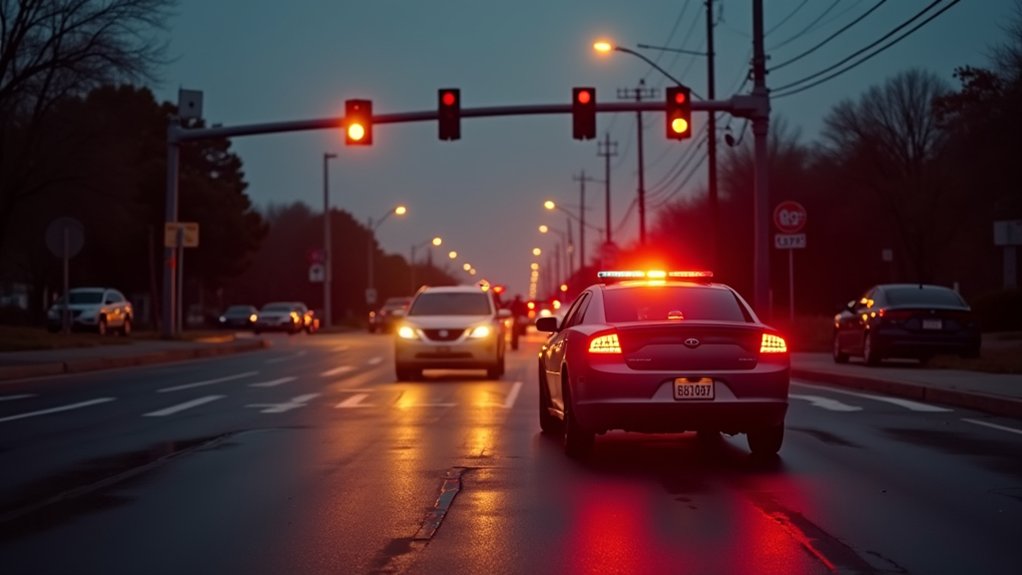
You’ll also scrutinize probable cause for arrest. Challenge whether bloodshot eyes or alcohol odor actually indicate impairment. Officers often investigate intoxication factors like slurred speech and open containers, but these observations alone may not establish sufficient grounds for an arrest. Highlight inconsistencies between police reports and bodycam footage to undermine the officer’s credibility. With passive alcohol detection systems becoming mandatory in new vehicles by 2026, defense attorneys must also examine whether data from these in-car sensors was properly collected and calibrated before being used as evidence against you.
Attacking Field Sobriety Test Administration and Reliability
Three standardized field sobriety tests, Horizontal Gaze Nystagmus, Walk-and-Turn, and One-Leg Stand, form the core of NHTSA’s validated battery, yet even these carry documented inaccuracy rates approaching 30% for detecting impairment. You’ll want your attorney to scrutinize whether officers followed exact NHTSA protocols, since deviations undermine scientific validity and can trigger suppression. Many people cannot perform these tests successfully even when completely sober, making baseline ability a crucial factor in your defense. Defense attorneys who complete NCDD NHTSA standardized training can effectively cross-examine officers who deviate from proper testing and scoring procedures.
Challenge these critical vulnerabilities:
- Non-standardized tests lack validation: Alphabet recitation, backward counting, and finger-to-nose exercises aren’t federally approved
- Limitations of roadside testing environments: Uneven surfaces, poor lighting, and weather degrade reliability
- Physical factors affecting performance: Age over 65, obesity, disabilities, and restrictive footwear cause non-alcohol-related failures
- Cultural biases in field sobriety assessment: Subjective clue interpretation varies between officers
- Scoring subjectivity: Inter-rater reliability remains questionable across jurisdictions
Disputing Breathalyzer Accuracy and Calibration Records

Breathalyzer evidence often appears bulletproof to juries, but every evidential breath analyzer carries inherent measurement uncertainty that skilled defense counsel can exploit. The Alcotest 9510, for example, specifies accuracy of ±0.002 BrAC or ±2%, whichever is greater, creating a defensible zone near statutory limits where your true BrAC may fall below the per se threshold.
Your attorney should demand complete calibration records, documenting instrument maintenance intervals and verification procedures. Administrative rules typically mandate calibration every 60 days; missed or late checks can support exclusion. Exposing lack of quality control procedures, such as missing reviewer signatures, expired reference standards, or calibration laboratories lacking ISO/IEC 17025:2017 accreditation, undermines the prosecution’s reliability claims. Defense attorneys should also verify that all calibrations maintain traceability to recognized metrological standards, as any break in this chain compromises the scientific validity of the breath test results.
Cross-examination should probe whether reported values were rounded or truncated and whether proper uncertainty analysis accompanied the results.
Exposing Blood Test Errors and Chain of Custody Violations
Blood test evidence isn’t bulletproof, you can challenge it by scrutinizing the draw procedure, sample handling, and documentation trail. Improper techniques like alcohol-based swabs, expired collection kits, or inadequate preservatives can contaminate samples or trigger fermentation that artificially inflates your BAC reading. Any gap in the chain of custody, from the moment the needle enters your arm to the lab’s final analysis, creates an opportunity to argue the results are unreliable and should be suppressed or discounted. Your attorney should also examine storage and transport conditions, since improper temperature control or delays in getting samples to the lab can compromise the integrity of the blood evidence. Your attorney can also request an independent re-analysis of the blood sample to verify or dispute the original findings.
Improper Blood Draw Procedures
When prosecutors introduce blood alcohol evidence, they’re relying on a complex chain of scientific procedures, and any break in that chain creates an opportunity to challenge the results.
Your defense should scrutinize every aspect of the blood draw process. Technicians must follow strict sample stabilization requirements, including proper anticoagulant mixing and adequate preservative levels. Violations of storage protocols, such as inadequate refrigeration or delayed analysis, compromise the sample’s integrity. Without proper preservation, samples can ferment and generate their own alcohol content, artificially elevating BAC readings.
Key procedural errors to target:
- Use of alcohol-based swabs at the puncture site, introducing exogenous contamination
- Collection tubes lacking required anticoagulants or preservatives
- Improper labeling that creates sample misidentification risks
- Deviations from jurisdictional standards like California Title 17 requirements
- Failure to properly invert and mix tubes immediately after collection
These deficiencies can render blood evidence unreliable or inadmissible. Additionally, a significant time lapse between arrest and blood draw can distort the accuracy of BAC readings, providing another avenue for challenging the prosecution’s evidence.
Sample Contamination and Fermentation
Even if a phlebotomist follows proper draw procedures, your blood sample remains vulnerable to contamination and fermentation errors that can artificially inflate BAC results long after collection.
Improper sample handling procedures create multiple attack vectors. Unrefrigerated storage, transport in hot vehicles, and inadequate sodium fluoride preservative levels allow bacteria to ferment glucose into ethanol inside the vial. This means your reported BAC may reflect post-collection alcohol production rather than your actual impairment level. Studies show that bacterial fermentation can increase BAC by 0.03%-0.08% when samples are collected in wrong tube types lacking proper preservatives.
Contamination presents equally serious concerns. Alcohol-based skin antiseptics, breached vial seals, and non-sterile equipment can introduce exogenous ethanol. Laboratory testing protocols failures, including chromatograph contamination and cross-contamination between samples, compound these issues. An expert witness in forensic chemistry can identify these equipment issues and testify to the technical complexities that may have compromised your results.
Your defense should demand documentation of storage temperatures, preservative concentrations, and testing timelines. Discrepancies between early and later test runs on identical samples often reveal ongoing fermentation.
Chain of Custody Gaps
Your defense attorney should scrutinize documentation for vulnerabilities that create reasonable doubt:
- Missing signatures or illegible entries indicating undocumented transfers
- Unexplained time gaps between handlers suggesting lost evidence periods
- Improper sealing or labeling violations on blood tubes
- Testimony inconsistencies about storage locations and security controls
- Unrefrigerated storage exceeding mandated time limits
These gaps don’t require proving actual tampering, they establish sufficient doubt about sample identity and integrity. When medical personnel are involved in the blood draw, hospital staff documentation may not meet the rigorous forensic evidence handling requirements necessary for criminal proceedings. Chain of custody issues are particularly critical because compromised sample integrity can cast enough doubt on the evidence to significantly weaken the prosecution’s case.
Presenting Rising Blood Alcohol and Medical Condition Defenses
To succeed, you’ll need a toxicologist who can perform retrograde extrapolation using your drinking timeline, body metrics, and test timestamps. A lower preliminary roadside reading compared to the station test provides empirical support. This pattern indicates that your BAC was still rising during the investigation, meaning your actual level while driving may have been below the legal limit. The landscape of DUI defense is also evolving as Biden’s 2021 Infrastructure Investment and Jobs Act introduces mandatory in-car breathalyzer technology that could reshape how these cases are approached.
Medical condition defenses offer another avenue. Conditions like GERD, diabetes, or auto-brewery syndrome can produce falsely elevated BAC readings or mimic impairment symptoms. You’ll need medical documentation and expert testimony establishing how your specific condition affected test accuracy.
Proving You Were Not Driving or in Control of the Vehicle

Beyond challenging the accuracy of BAC results, another powerful defense targets the “driving” element itself, a component the prosecution must prove beyond a reasonable doubt. You can exploit gaps in evidence preservation by demanding dashcam footage, surveillance recordings, and vehicle data logs that may show no movement occurred. Attacking witness credibility becomes critical when officers arrive post-incident and assume you were driving.
Challenging the driving element forces prosecutors to prove you actually operated the vehicle, not just that you were nearby.
Key strategies to negate the driving element:
- Present GPS data, ignition logs, or event recorder evidence showing no recent vehicle operation
- Demonstrate keys were inaccessible, stored in the trunk, held by another person, or outside the vehicle
- Establish you occupied a non-driver seat, indicating no intent to operate
- Produce eyewitness testimony or security footage identifying another driver
- Highlight investigative failures to canvass for independent witnesses or preserve video evidence
Negotiating Reduced Charges and Alternative Sentencing Programs
Even when challenging the driving element or BAC evidence doesn’t guarantee acquittal, these defense strategies serve a dual purpose, they create substantial leverage for negotiating plea bargains that carry far fewer consequences than a standard DUI conviction.
Your attorney can pursue reductions to reckless driving, “wet reckless,” or “dry reckless” charges, each offering progressively fewer collateral consequences. First-time offenders with low BAC readings and clean records hold the strongest negotiating position, particularly when evidentiary weaknesses exist.
Alternative sentencing programs provide another pathway. Diversion programs often dismiss charges entirely upon completing alcohol education and community service. Specialized DUI courts combine treatment with judicial oversight for eligible defendants.
The staged negotiation approach proves critical, never accept initial offers. Prosecutors expect counteroffers, and thorough evidence review combined with strategic motion practice consistently produces more favorable terms.
Facing DUI Charges in Georgia?
A DUI charge can put your license and your record at risk. At Cobb Defense, Attorney Gregory Chancy and his team help clients across Marietta and Cobb County fight these charges and work to get them reduced or dismissed. If you need help with DUI defense, call (770) 627-3221 today for a free consultation.
Frequently Asked Questions
How Much Does Hiring a Specialized DUI Defense Attorney Typically Cost in 2026?
You’ll typically pay $1,500, $5,000 in legal fees for first-offense DUI representation in 2026, while repeat or felony charges often run $5,000, $10,000+. Top-tier specialists in major metros command $10,000, $25,000 for complex, trial-heavy cases. Hourly rates range from $200, $500, though many attorneys offer flat-fee structures. You should inquire about payment plans, as numerous firms provide financing options to help you secure specialized defense without upfront financial strain.
Will a DUI Conviction Affect My Professional License or Employment Opportunities?
Yes, a DUI conviction can seriously jeopardize your career. You’ll face potential license suspension from state boards that classify DUI as unprofessional conduct, particularly in healthcare, law, and transportation sectors. Beyond licensing, you’ll experience significant professional reputation impact, employers routinely conduct background checks, and many industries maintain zero-tolerance policies. You must self-report convictions to licensing boards; failing to disclose triggers additional violations. Multiple offenses dramatically increase your risk of permanent license revocation.
How Long Does a DUI Case Typically Take From Arrest to Resolution?
Your DUI case typically takes 1, 4 months if you accept an early plea, but expect 6 months to 1.5 years if you contest charges through trial. Legal process delays, including crowded court dockets, motion practice, and discovery disputes, significantly extend timelines. Meanwhile, the impact on driver’s license occurs immediately: you’ve got just 10 days to request a DMV hearing, or automatic suspension begins on day 30, running parallel to your criminal case.
Can I Expunge a DUI Conviction From My Record After Completing My Sentence?
Yes, you can pursue expunging a DUI conviction after completing your sentence, but record expungement eligibility varies substantially by state. You’ll need to satisfy waiting periods (typically 1, 10 years), pay all fines and restitution, and maintain a clean record. First-time misdemeanor offenses generally qualify, while felony DUIs involving injury or death often don’t. File your petition strategically, gather completion documentation, anticipate prosecutorial objections, and demonstrate rehabilitation to maximize judicial approval.
What Happens to My Car Insurance Rates After a DUI Arrest or Conviction?
Your insurance rates typically increase 70, 87% after a DUI, though rate increases can spike 300%+ depending on your state, insurer, and prior record. You’ll face these surcharges for 3, 5 years minimum. Some carriers pursue policy cancellation entirely, forcing you into high-risk markets with SR-22 filing requirements. Strategically, your choice of insurer matters considerably, companies vary widely in DUI pricing, and securing favorable legal outcomes can substantially mitigate long-term premium impact.