You’ll find law enforcement gun rights in 2025 shaped by the LEOSA Reform Act‘s expanded concealed carry privileges and streamlined requirements. Federal guidelines now allow officers to maintain retired service weapons while following strict security protocols. State-level changes have broadened cross-jurisdictional authority and training standards, though requirements vary substantially by location. Understanding these evolving regulations proves essential as you navigate the complex intersection of officer rights and public safety concerns.
The LEOSA Reform Act: Expanded Concealed Carry Privileges

While the Law Enforcement Officers Safety Act (LEOSA) has historically provided concealed carry rights to qualified law enforcement personnel, the LEOSA Reform Act of 2025 vastly expands these privileges across multiple jurisdictions and settings. You’ll find significant changes in Title 18 of the U.S. Code, particularly regarding school zones and public spaces like shopping malls and mass transit. How qualified immunity works is essential for understanding the legal protections afforded to law enforcement officers. This doctrine often shields officers from liability even in cases of alleged misconduct.
The Act streamlines concealed carry requirements and removes previous restrictions that limited off duty incidents response capabilities. It’s designed to enable faster active shooter response by qualified officers while maintaining essential safeguards. You won’t see these privileges extended to officers with mental health disqualifications or violent convictions. Under the new reform, officers’ training certification period extends from 12 to 36 months for qualified retired personnel. The reform addresses pivotal gaps in federal law where LEOSA exemptions previously didn’t apply, while still respecting state-level regulations in non-federal jurisdictions.
New Federal Guidelines for Law Enforcement Firearms
Building upon LEOSA’s expanded concealed carry framework, new federal guidelines in 2025 have transformed how law enforcement agencies manage their firearms programs. Under H.R.2255, you’ll find streamlined firearm resale logistics through GSA-managed programs, allowing eligible officers to purchase their retired service weapons. Storage security protocols have become increasingly stringent, with detailed requirements for securing retired firearms. The program ensures that federal law enforcement officers can maintain ownership of their trusted service weapons after retirement. Regular compliance inspections help verify proper recordkeeping and security measures for retired service weapons. The recent ATF merger proposal could impact how these programs are administered and supervised going forward.
Federal law H.R.2255 modernizes police firearm programs, simplifying how officers can acquire retired service weapons while enhancing security measures.
- You must demonstrate proof of duty-issued firearms when participating in federal purchase programs
- You’ll need to comply with both state and federal licensing standards, which vary by jurisdiction
- You’re required to follow improved storage requirements and security measures for retired service weapons
These guidelines reflect a balanced approach between officer access and public safety, with ATF maintaining oversight despite reduced inspection frequencies. Getting pulled over by law enforcement can often lead to increased anxiety for drivers. It is essential for individuals to understand their rights and how to interact calmly during these encounters.
State-Level Changes Affecting Police Officers
State reforms in 2025 have fundamentally reshaped law enforcement officers’ firearm rights across jurisdictions. Through reciprocity agreement impacts, you’ll find expanded recognition of out-of-state handgun licenses, particularly in Texas under SB 706. These changes streamline your ability to maintain concealed carry privileges while working across state lines.
While private property owners can typically restrict firearms, holster requirements must still be followed when carrying is permitted. You’ll notice significant private property carry concerns have been addressed through new legislation permitting officer access to previously restricted zones. This includes shopping centers, transit hubs, and school zones, where you’re now authorized to carry with appropriate training. States have also clarified unlicensed carry policies, often exempting law enforcement from general restrictions while maintaining public safety standards. These reforms reflect a balanced approach between property owner rights and the need for bolstered security in commercial and educational environments. Additionally, officers should note that gun buyback programs are no longer permitted at the local level in Texas, impacting department-community initiatives. The elimination of Federal Law Enforcement Training Centers would severely impact the professional development of 20,000 officers annually.
Training Requirements and Compliance Standards
As law enforcement training evolves in 2025, you’ll encounter exhaustive firearms qualification standards that emphasize both technical proficiency and tactical judgment. The updated requirements demand an 80% scoring threshold on SQT-A1 targets, with instructor verification ensuring proper execution across multiple shooting positions and distances. Due to security reasons, certain training locations may have temporarily restricted access. The site owner restrictions have been implemented to maintain strict control over sensitive training areas.
Your annual requalification will require mastery of:
- 30 rounds distributed across 15-, 7-, and 3-yard lines under strict time constraints
- Multiple shooting positions including holster, high-ready, and low-ready stances
- Advanced scenarios incorporating movement, reloads, and tactical decision-making
The thorough 8-hour minimum training encompasses live-fire exercises, written assessments, and critical instruction on firearm safety and self-defense laws. This structured approach aligns with evidence showing that mandated live-fire training correlates with reduced gun violence incidents in law enforcement encounters. Research demonstrates that officers with less training experience are more likely to make critical errors in high-pressure shooting scenarios.
Balancing Officer Rights With Public Safety Concerns
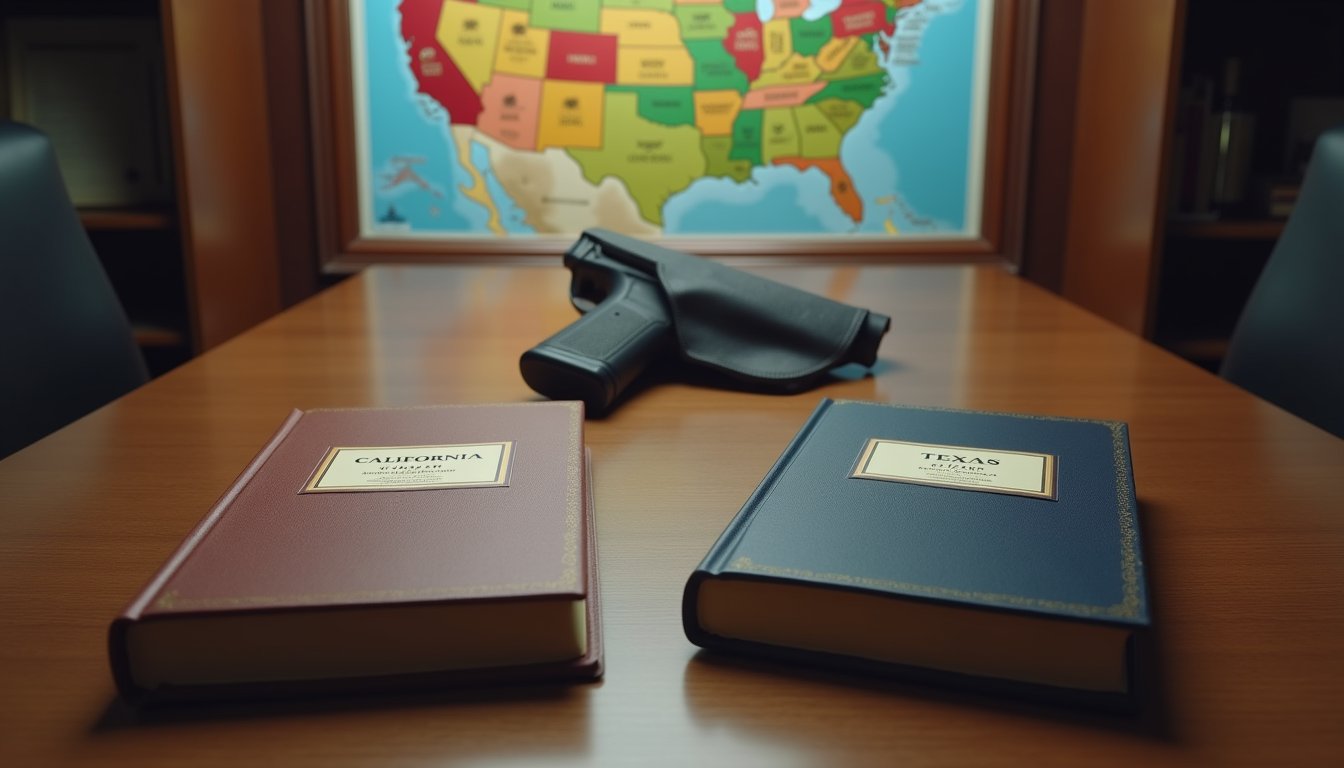
Modern law enforcement faces complex challenges in reconciling officers’ firearm rights with mounting public safety concerns. You’ll notice significant variations across states, with California’s strict regulations contrasting sharply against weaker laws in Texas, Kansas, and Utah. These disparities create operational realities that affect how officers must adapt their tactics and responses. Police body cameras have become essential tools for enhancing transparency and accountability in law enforcement. They serve to document interactions between officers and the public, which can be critical in resolving disputes.
California’s score of 90.5 ranks highest nationally for gun law strength. States like Arkansas and Mississippi have weak gun laws with index scores of just 4.5, creating stark regulatory differences. Law enforcement burdens increase when neighboring jurisdictions have conflicting regulations. While states like Texas maintain looser restrictions, showing near-average violence rates, they contribute to cross-border trafficking challenges. You’ll need to ponder how Project 2025’s potential rollback of gun safety measures could impact officer safety protocols. The data shows that states with stronger regulations typically demonstrate lower youth mortality rates, though external threats from weak-law states continue to pose enforcement challenges. Studies indicate that weakening concealed carry requirements leads to a 13% decline in violent crime clearance rates.
Frequently Asked Questions
How Do Off-Duty Officers Identify Themselves When Carrying Concealed Firearms?
When carrying concealed firearms, you must follow strict off-duty identification protocols by presenting your agency-issued photographic ID. This identification must show your current employment status and weapons authorization. Your concealed carry guidelines require proof of firearms qualification within the past time period. You’ll need to maintain these credentials at all times while armed, ensuring they validate both your law enforcement status and weapon authorization.
What Happens if an Officer’s Weapon Is Stolen While Carrying Under LEOSA?
If your weapon is stolen while carrying under LEOSA, you must immediately report the theft to law enforcement and your certifying agency. You’ll face heightened liability concerns if the stolen firearm is used in offenses. Your LEOSA privileges may be scrutinized, and you’ll likely need to complete supplementary weapon retention training. Neglecting to report the theft promptly could result in certification revocation and potential criminal charges under federal law.
Can Retired Officers Carry Ammunition Types Restricted by State Laws?
Yes, you can carry ammunition types restricted by state laws when you’re qualified under LEOSA. The Reform Act explicitly exempts you from state-level ammunition restrictions, overriding local concealed carry limitations. While you’ll need to maintain your “qualified retired law enforcement officer” status and meet annual training requirements, you won’t face ammunition compatibility issues across jurisdictions. This federal preemption guarantees you can carry standard or specialized rounds that would otherwise be prohibited by state regulations.
Do LEOSA Rights Extend to Private Security Personnel With Law Enforcement Experience?
No, you won’t qualify for LEOSA rights if you’re working in private security, even with prior law enforcement expertise. Private security considerations are explicitly excluded from LEOSA coverage unless you’re directly employed by a government agency as a sworn officer. The liability implications are significant you must rely on standard state licensing and concealed carry permits like other private security personnel. Only current and qualified retired government law enforcement officers receive LEOSA privileges.
How Are Interstate Firearms Qualification Standards Verified for Traveling Officers?
When you travel across state lines as a law enforcement officer, your firearms qualifications are verified through national databases and reciprocity agreements between states. You’ll need to maintain proper documentation from your originating agency, and your credentials can be checked through online verification systems. You must meet the qualification standards of both your home state and any jurisdiction you’re entering, with particular attention to MPOETC standards for cross-state recognition.