If you’re carrying a second gun on duty, you’ll need to navigate a layered legal landscape. Your state’s statutes may defer to agency policy, but the absence of a ban doesn’t equal authorization. You must register and qualify with every firearm you carry, failing to do so risks disciplinary action, loss of departmental liability coverage, and even criminal prosecution. Understanding how policy, law, and liability intersect is essential before you strap on that backup.
Why Departments Disagree on Allowing a Second Gun on Duty
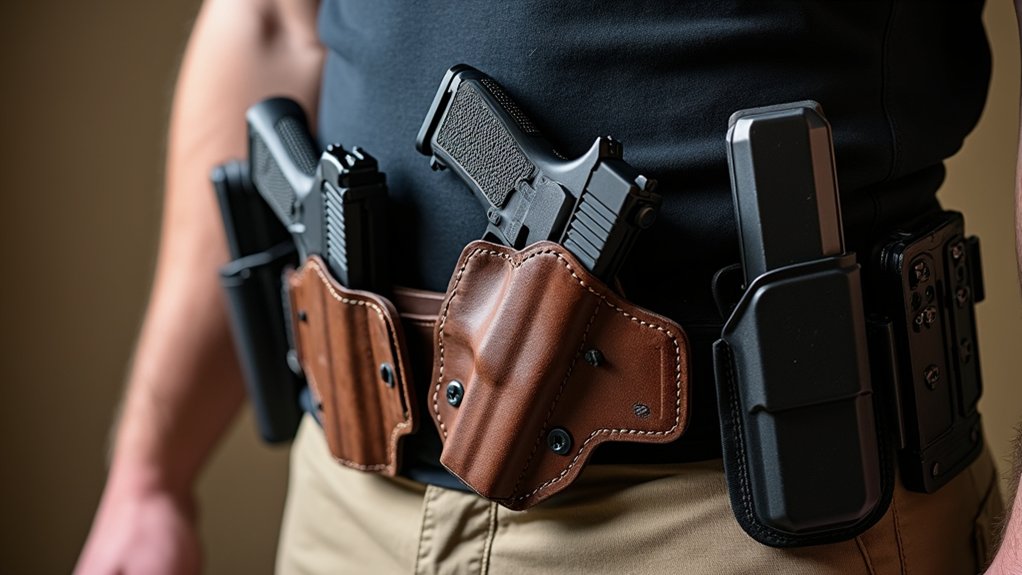
Whether a department permits or prohibits backup firearms often comes down to how administrators weigh competing risks. You’ll find some agencies cite weapon retention concerns, arguing that controlling two firearms during physical altercations creates greater danger than carrying one. Others point to budgetary constraints, noting they can’t fund BUG-specific qualification courses or ongoing training requirements.
Liability exposure drives much of the debate. When you’re managing multiple firearms laws, your department assumes legal responsibility for establishing adequate training standards. Without proper qualification protocols, agencies face expensive litigation. Jurisdictional crime assessments also factor in, low-crime departments may prohibit backup weapons based on perceived reduced need, while higher-threat jurisdictions recognize their tactical value. Standardization preferences further restrict individual officer flexibility regarding secondary firearms. Beyond operational factors, tradition and political considerations, along with community relations, heavily influence administrative decisions, as some departments deliberately avoid public discussion about their firearms policies.
State Laws That Restrict Officers From Carrying a Backup Gun
You need to understand that state statutory carry limits can directly affect whether you’re authorized to carry a backup firearm on duty, even when your department’s policy permits it. Agency-imposed legal barriers, often derived from state administrative codes or attorney general opinions, may further narrow your options by specifying approved weapon types, calibers, or carry configurations. Certain jurisdictions maintain outright prohibitions or restrictive conditions that expose you to disciplinary action or criminal liability if you carry an unauthorized second gun. For example, the Washington, D.C. Metro Transit Police has forbidden backup guns since 1976, affecting 377 officers under a policy that has remained unchanged and is not currently under review.
State Statutory Carry Limits
Most states don’t impose explicit statutory limits on the number of firearms a law enforcement officer can carry while on duty. Instead, state statutory carry limits typically defer to agency policy and departmental regulations. You’ll find that most state penal codes exempt on-duty officers from civilian carry restrictions rather than imposing additional limitations on backup weapons.
However, you shouldn’t assume this absence of statutory restriction equals blanket authorization. Some states regulate firearm types, calibers, or ammunition through administrative codes governing law enforcement standards. If your state’s POST commission or regulatory body sets specific equipment standards, those carry the force of law. Certain restrictions may also be triggered by specific words or phrases embedded in administrative code language that define prohibited weapon categories or configurations.
You must verify your state’s current statutory framework, since legislative changes can introduce new restrictions without widespread notice. Non-compliance exposes you to criminal liability and professional decertification.
Agency-Imposed Legal Barriers
Beyond statutory carry limits, certain states impose agency-level legal barriers that can effectively prevent officers from carrying backup firearms on duty. These restrictions function through regulatory frameworks that bind departments to specific authorization protocols.
You’ll encounter three primary agency-imposed legal barriers:
- Mandatory qualification requirements, You must demonstrate proficiency with every firearm you carry, and failure to qualify eliminates your authorization immediately.
- Approved weapons lists, Your agency may restrict backup firearms to specific makes, calibers, or models, narrowing your options considerably.
- Liability and indemnification clauses, If you carry an unauthorized backup weapon, you risk losing departmental legal protection in use-of-force incidents.
Non-compliance with these barriers exposes you to disciplinary action, personal civil liability, and potential criminal charges under state regulatory provisions.
Jurisdiction-Specific Prohibition Examples
While most states don’t explicitly prohibit law enforcement officers from carrying backup firearms, a handful of jurisdictions impose statutory restrictions that limit or condition this practice. You’ll find that state-level prohibitions are rare, but regulatory frameworks can effectively restrict backup firearm legality through licensing, certification, or qualification mandates that create practical barriers.
You should note that current legal research doesn’t identify specific state statutes that outright ban backup firearms for on-duty officers. Instead, restrictions typically emerge through administrative code provisions and agency-level regulations operating under state authority. If you’re evaluating your compliance obligations, don’t rely solely on the absence of explicit prohibitions. You must examine your state’s administrative regulations, police standards commissions, and POST board requirements, as these bodies often impose binding conditions that carry statutory enforcement weight.
Department Rules That Ban Backup Guns Without Saying So
- Standardization requirements as implicit barriers, departments restrict officers to issued weapons only, citing training uniformity as justification.
- Weapon retention and throwdown gun concerns, agencies limit weapon sourcing to eliminate liability risks associated with unaccounted secondary firearms.
- Discretionary enforcement, supervisors apply unwritten standards without documented policy rationale.
You’re bound by these restrictions regardless of whether they appear in your department’s official handbook. Non-compliance exposes you to disciplinary action and professional liability.
Liability and Misconduct Concerns Behind Second Gun Restrictions
The restrictions outlined in the previous section don’t exist in a vacuum, they’re rooted in documented liability exposure and misconduct patterns that’ve shaped how agencies evaluate secondary firearms. When you carry an unauthorized backup weapon, you create a direct liability chain that extends from you to your department. Agencies restrict secondary firearms precisely because unregistered weapons complicate use-of-force investigations and increase civil litigation risk.
Understanding the liability and misconduct concerns behind second gun restrictions requires examining how unauthorized weapons have figured into evidence-tampering allegations and excessive force claims. If you’re carrying a second gun that hasn’t been logged, qualified, and approved, you’re exposing yourself to criminal prosecution and your agency to vicarious liability. Departments weigh these risks against operational benefits, and restrictions reflect that calculated assessment.
Training and Qualification Standards for Carrying a Second Gun
If you carry a second gun on duty, you’re typically required to qualify with it annually under the same department-approved protocols that govern your primary service weapon, including timed drills for loading, malfunction clearing, and accuracy at distances up to 15 yards. Despite this requirement, over 72% of law enforcement agencies lack formal training programs for off-duty or concealed carry firearms, leaving critical gaps in your preparedness with a backup weapon. This disconnect between policy mandates and available training resources means you must take ownership of your qualification readiness, because your department’s carry authorization hinges on documented competency with every firearm you bring on duty.
Qualification Frequency Requirements
Because qualification frequency requirements directly affect an officer’s legal authority to carry any firearm on duty, understanding these standards isn’t optional, it’s a professional mandate. When carrying a second gun while on duty, you must meet identical qualification thresholds as your primary weapon.
You’re required to adhere to these critical benchmarks:
- Semi-annual qualification: You must qualify at least twice yearly with each approved firearm, with attempts separated by a minimum of 90 days.
- Annual backup weapon qualification: You must pass the Handgun Qualification Course annually with all Department-authorized firearms, regardless of carry frequency.
- Scoring minimums: You must achieve at least 70% on every course of fire, with no more than two attempts permitted per session.
Failing any requirement jeopardizes your commission and exposes you to significant liability.
Department Training Gaps
Even when officers meet every qualification benchmark on schedule, systemic training gaps within departments can undermine the safety and legal protections those standards are meant to provide. You may qualify with your backup firearm yet receive no scenario-based training addressing secondary weapon deployment under stress.
Department training gaps frequently manifest in critical areas: shift drills between primary and backup weapons, retention techniques for concealed carry positions, and legal decision-making frameworks governing secondary firearm use. If your department lacks structured curricula addressing these competencies, you’re exposed to heightened liability.
You should document any identified deficiencies and formally request supplemental instruction. Administratively, departments must guarantee compliance extends beyond paperwork, like New Jersey’s SP 182A requirements, to encompass substantive tactical proficiency. Failing to address these gaps creates institutional risk you can’t afford to ignore.
Policy-Driven Carry Decisions
Whether your department explicitly codifies secondary weapon authorization or relies on informal approval, policy-driven carry decisions dictate every aspect of how you select, train with, and deploy a backup firearm on duty.
Understanding law enforcement firearm policies requires you to address three critical compliance areas:
- Weapon registration, You must formally register any secondary firearm with your agency, ensuring it meets approved specifications for caliber, size, and carry method.
- Qualification standards, You’re required to demonstrate proficiency with your backup weapon through departmental qualification courses, typically on the same schedule as primary weapon certifications.
- Liability accountability, You carry personal and departmental liability for every round fired from an unauthorized or unregistered secondary weapon.
Non-compliance exposes you to disciplinary action, termination, and criminal prosecution. Policy adherence isn’t optional, it’s your legal shield.
Where Officers Can and Cannot Carry a Backup Weapon
Although many departments permit officers to carry backup weapons, the specific locations where they can deploy those firearms on their person vary widely based on departmental policy, holster type, and operational role. You must familiarize yourself with applicable backup gun laws before selecting a carry position, as non-compliance creates significant liability exposure.
Ankle holster placement remains among the most common deployment locations for secondary weapons. However, your department may restrict carry positions based on weapon retention concerns, a rationale cited by agencies including the Botetourt County Sheriff’s Office, Norwich Police Department, and University of Maryland’s Department of Public Safety. If your agency permits backup firearms, you’ll typically need commander approval and must submit your secondary weapon for department inspection before you’re authorized to carry it in any approved location.
Real-World Incidents Where a Second Gun Made the Difference
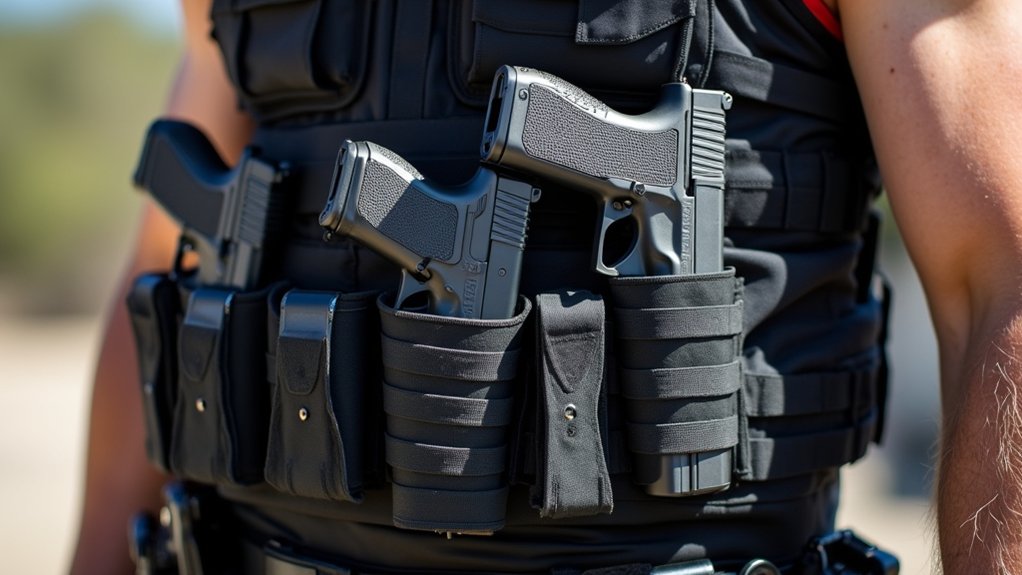
Because documented case data on backup weapon deployments remains limited in publicly available records, analyzing real-world incidents where a second gun made the difference requires drawing from law enforcement after-action reports, use-of-force reviews, and verified defensive gun use case studies.
You should recognize that firearm carry policies exist precisely because backup weapons address identifiable operational risks:
- Primary weapon malfunction, mechanical failures during critical encounters leave you vulnerable without a secondary option.
- Ammunition depletion, extended engagements can exhaust your primary magazine capacity, making a backup firearm essential.
- Weapon retention failures, if you lose control of your primary firearm during a physical altercation, a concealed backup provides a last-resort defensive capability.
Without thorough incident databases, you must rely on agency-level documentation to justify backup weapon authorization within your department’s policy framework.
What Officers and Departments Should Weigh Before Setting Policy
Before any department commits a backup firearm policy to writing, decision-makers must reconcile three distinct layers of legal authority, state statute, federal law under LEOSA, and internal agency regulations, each of which imposes its own requirements and restrictions. You can’t adopt one framework while ignoring the others without creating liability exposure.
Your policy must define “approved firearm” with specificity, establish qualification frequency, and set minimum scoring benchmarks, typically 70% or higher. You should also clarify how off-duty firearm carry rules intersect with on-duty backup authorization, since LEOSA may supersede certain off-duty restrictions while leaving on-duty departmental authority intact.
Address federal property prohibitions explicitly. Officers must understand that LEOSA doesn’t exempt them from carrying restrictions in schools, federal buildings, or privately restricted areas.
Frequently Asked Questions
Can Private Security Guards Legally Carry a Second Firearm While on Duty?
You generally can’t carry a second firearm while on duty as a private security guard. States like California and Missouri explicitly limit you to one approved weapon. You must register your firearm with the state licensing authority and obtain employer authorization. Carrying an unauthorized second gun risks license revocation, disciplinary action, and criminal liability. You should review your state’s specific regulations and your employer’s policies to guarantee full compliance.
Do Federal Agents Follow Different Backup Gun Rules Than Local Police?
Yes, you’ll find that federal agents typically operate under distinct backup gun policies compared to local police. However, the available information doesn’t detail specific federal agency regulations. You should know that local departments set their own qualification and approval standards, while federal agencies like the FBI or Secret Service maintain separate internal policies. You’d need to consult each agency’s specific guidelines, as rules vary considerably between federal and local jurisdictions.
Can Officers Carry Backup Guns While Working Off-Duty Security Jobs?
You can carry a backup gun while working off-duty security, but you’ll need to satisfy overlapping requirements. You must comply with your primary agency’s backup weapon policies and your security employer’s firearm rules. Under 18 USC 926B, you retain qualified officer carry rights, though state laws like Illinois’s may restrict carry to active duty hours and direct commutes. Non-compliance risks disciplinary action, liability exposure, and potential criminal charges.
Are Retired Law Enforcement Officers Permitted to Carry Backup Firearms Under LEOSA?
You can carry a backup firearm under LEOSA, but you must qualify annually with each specific weapon type you intend to carry. If you’re carrying both a revolver and a semi-automatic, you’ll need separate qualifications for each. You must also maintain valid photographic credentials and current qualification documentation. Without meeting these requirements for every firearm, you risk losing your LEOSA exemption and facing potential legal consequences.
Does Carrying a Second Gun Affect an Officer’s Workers’ Compensation Claims?
You could jeopardize your workers’ compensation claim if you’re carrying an unauthorized second firearm when injured on duty. If your agency hasn’t approved the backup weapon, insurers may argue you violated departmental policy, potentially reducing or denying benefits. You should guarantee every firearm you carry meets qualification and authorization requirements. Consult your agency’s legal counsel and union representative to confirm you won’t create coverage gaps that undermine your claim.